Showing posts with label Governments. Show all posts

Saturday, March 25, 2017

Indian Politician Labels Bitcoin a ‘Pyramid Ponzi Scheme’, Calls for Regulation

An Indian politician has raised his concerns about the increasing use and adoption of bitcoin in the country with the Indian Parliament, questioning its legitimacy as a currency. He has also called for its regulation by India’s financial authorities.
Kirit Somaiya, a member of parliament and a politician from the BJP, India’s ruling party at the center, has insinuated that bitcoin is a “pyramid ponzi scheme” citing unnamed experts while he plainly deemed it a “hypothetical currency.”
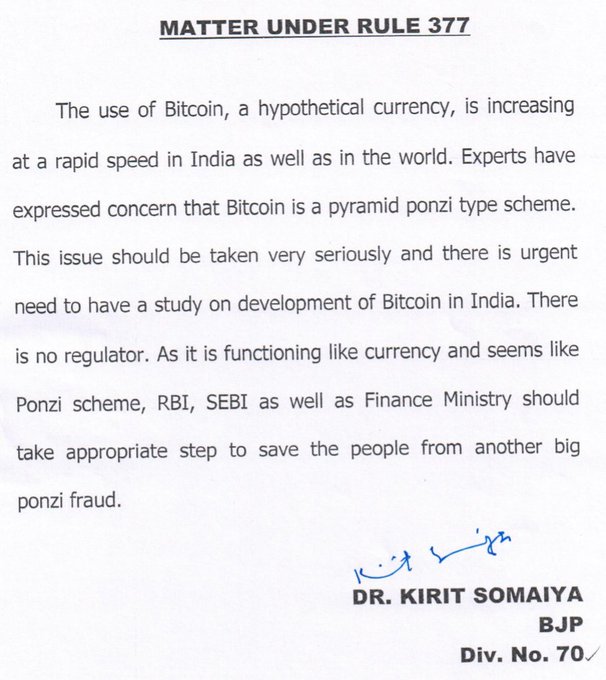
Raising his concerns in the Indian Parliament, Somaiya’s issue with the world’s most prominent cryptocurrency reads:
The use of Bitcoin, a hypothetical currency, is increasing at a rapid speed in India as well as in the world. Experts have expressed concern that Bitcoin is a pyramid ponzi type scheme. This issue should be taken very seriously and there is [an] urgent need to have a study on development of Bitcoin in India. There is no regulator. As it is functioning like [a] currency and seems like [a] Ponzi scheme, RBI and SEBI as well as Finance Ministry to take [the] appropriate step to save the people from another big ponzi fraud.
Somaiya, who graduated as a chartered accountant in the late 70s and was conferred with a ‘Ph.D in Finance – Capital Market – Small Investors Protection’ in 2005, has submitted his above-stated concerns to the Indian Finance Ministry and the Reserve Bank of India (the country’s central bank) as well as other authorities.
View image on TwitterView image on Twitter
Is @Bitcoin a Scam? Ponzy? Hypothetical Currency? I raise issue in Parliament I requested @RBI GOI 4 action Understood GOI formed a Comittee
Somaiya’s concerns are presumably based on bitcoin’s meteoric rise in over the course of its recent history. At this time, last year, bitcoin was trading near $420. A year later, bitcoin reached an all-time high of $1,350 earlier this month and is currently trading at just under $1,000.
The bitcoin skeptic appeared in a televised interview with a regional news channel today, where the host insisted that countries around the world were already acknowledging bitcoin as a currency.
“Many countries in the world allow bitcoin. They allow blockchain technology. Virtual currencies are legally recognized overseas in the United States, in Japan and other developed economies. So, what is the harm if India were to consider it (bitcoin as a legal currency)?”, the host questioned.
To this, Somaiya stated:
I don’t know about other countries, but somebody has to regulate [bitcoin].
At this point, it can be inferred that the politician’s concerns stem from a lack of regulation of the cryptocurrency. The lack of regulations gives room to the possibility of ponzi schemes based on bitcoin. The abuse of the cryptocurrency has also been prevalent in countries around the world, with notable examples in KenyaVietnamChinaNigeria and the United States.
Earlier this month, an official from the Indian Crime Branch claimed an increase in cases of bitcoin fraud in the country. Notably, Indian bitcoin companies have started a self-regulatory body to address a growing number of bitcoin-based MLM schemes in the country.
However, the politician then slipped his true thoughts about digital currencies and his reasons for regulating them.
Let my country study, regulate, develop a [regulatory] system. Are we going to allow the private people to start their own currency? Then what is the meaning of civilized society? It has to be regulated.
Indian authorities’ stance toward bitcoin, conveyed through the central bank, is a cold shoulder. In early February, the apex bank issued a public notice, a rehash from December 2013, stating that bitcoin nor any companies (exchanges) dealing with the cryptocurrency were not recognized by the government.

Featured image of Indian Parliament building from Shutterstock.

Wednesday, March 22, 2017

Chinese Bitcoin Exchanges Seek Customers’ Funds Details; Withdrawals to Resume?

In what is perhaps the first notable step toward resuming bitcoin withdrawals for Chinese users after February’s freeze, at least one of China’s ‘big 3’ exchanges, Huobi, is now requiring details of users’ fiat funds used to buy bitcoins or digital currencies.
As revealed by regional industry news resource cnLedger, Huobi explains that the information sought is in accordance with AML regulations by the People’s Bank of China, the country’s central bank. Specifically, the exchange is soliciting emailed responses from users to provide explanations for the sources of the (fiat) funds transferred to the exchange and the destination account to which they wish to withdraw their digital currencies.
The step could come as a relief to users left in limbo after Huobi announced it would pause bitcoin and litecoin withdrawals over a month ago. Withdrawals were expected to resume earlier this month. However, Huobi and a number of exchanges postponed account withdrawals a day before the 30-day freeze ran its course, stating withdrawals would only resume after regulatory approval. No timelines were provided.
Translated by the news resource, Huobi’s notice, which cnLedger stresses as unconfirmed, reads:
According to AML regulations by government departments including the Central Bank and China Banking Regulatory Commission, you are required to provide explanations of the sources of your funds, and the destinations of the crypto-coins you withdraw.
Aside from seeking its users’ account details from Huobi, the requirements turn invasive when seeking explanations for the sources of funds transferred to Huobi and the proof for it.
For instance, if customers transferred money borrowed from acquaintances or friends, they are required to provide screenshots of the communication WeChat, a popular Chinese messaging platform, if IOU documents are unavailable.
Further, users are also required to explain the use to their bitcoins or litecoins acquired or stored on Huobi.
“The documents and materials you provide will be sent to national departments [to be] archived as proof,” states a reminder toward the end of the notice, urging users not to fabricate any details.
Hat tip to cnLedger.
Featured image from Shutterstock. 

Monday, March 20, 2017

Chinese Regulators Propose Rules for Bitcoin Exchanges

The People’s Bank of China (PBOC) has proposed revisions to its anti-money laundering (AML) requirements for bitcoin exchanges, according to Zhou Xuedong, director of the National People’s Congress and the bank’s department of business administration, according to Finance New Media.
Despite recent actions with virtual currency exchanges, the central bank has not laid out any clear set of regulations upon the bitcoin industry in the country.
Xuedong has called for China to look at regulatory efforts toward bitcoin internationally to establish a regulatory mechanism for the industry.

KYC Requirements Needed

Under the rules established in 2013, there are no know your customer (KYC) requirements. There was a requirement concerning bit currency risk for trading platforms to identify users’ identities, including real name, registration name, identity card numbers and other information.
The proposed change includes two aspects regarding AML. One is to establish an AML structure to improve AML, anti-terrorism financing and an internal control system. Another is to clarify the platform’s obligations, including prevention and control measures. Such measures would include customer identity information, a system for preserving transaction records and a system for recording suspicious transactions.
Virtual platforms will need to have “on-site certification.” The trading platform will have to follow the KYC principle and establish a system for customer identification. When users of virtual currency make withdrawals and redemptions, they will be required to have a valid identity document. Customers applying for counterfeit goods, virtual goods and the equivalent of more than 50,000 yuan should provide remote video certification.

Customer ‘Presence Certification’

The customer for the first time would be required to have “presence certification.”
In addition to making detailed requests for customer identification, the proposal stipulates that the platform should develop senior management personnel responsible for AML and anti-terrorism financing, and establish specialized agencies and positions and an internal control system.
The platform should properly store customer identity information and transactions to ensure complete and accurate reproduction of each transaction.
The proposal also includes a list of suspicious transactions to focus on. Should a transaction involve criminal activities like money laundering, the platform should report it to the central bank business management department.
Xuedong said the whereabouts of funds can be learned from the blockchain technology.

On-Site Exchange Inpsections Begin

Since the beginning of January 2017, the People’s Bank of Beijing, Shanghai and other branches of the joint local financial regulatory authorities have carried out on-site inspections of exchanges that found the AML internal control system is not perfect.
On January 11, the Shanghai and Beijing branches of the PBOC conducted on-site checks of three bitcoin exchanges, sending prices crashing. Exchanges in the country began enforcing sweeping changes, beginning with halting leveraged or loan-based trading of the cryptocurrency between platforms a week after the PBOC became involved. On January 24, Chinese exchanges ended zero-fee trading and began charging a flat 0.2 percent fee of the value of the transaction.
The central bank continued its investigation of Chinese bitcoin exchanges in February. A closed door meeting with a number of domestic exchanges took place on February 8.
On February 9, a notice was issued to upgrade the AML system and that the standard development and implementation period was expected to be one month.
On March 8, a notice mentioned the need to address AML, foreign exchange management, payment settlement and other financial regulations.
Featured image from Shutterstock.

Thursday, March 16, 2017

New EU Draft Law Seeks to Identify Bitcoin Users, End Anonymity

A newly drafted proposal to amend the existing directive of preventing money laundering and terrorism financing is seeking to introduce significant regulatory authority over the usage of digital currencies like bitcoin.
Members of the European Parliament (MEPs) are deliberating to extend the scope of the Anti-Money Laundering Directive (AMLD) to include virtual currencies, a move that could end the anonymity of cryptocurrency adopters and users.  The existing AMLD, published in May 2015, does not include any mention or coverage of virtual currencies.
CCN reported on a separate proposal put forth by the European Parliament and the Council of the European Union in January this year, one that called for the establishment of a preventative framework at a time where technology is driving alternative financing solutions. It too eventually sought to identify bitcoin users.
Published last week, the newest proposal [PDF] plainly states that “competent authorities should be able to monitor the use of virtual currencies,” whilst adding that anonymity would be a “hindrance than an asset for virtual currencies” when used for criminal purposes.
To this end, the draft law seeks to allow watchdogs from individual EU countries to identify bitcoin users by their bitcoin addresses.
An excerpt from the proposal reads:
To combat the risks related to the anonymity, national Financial Intelligence Units (FIUs) should be able to associate virtual currency addresses to the identity of the owner of virtual currencies.
The EU Parliament could soon regulate cryptocurrencies like bitcoin.
Also among the list of AMLD amendments proposed by the new draft law, specifically “with respect to virtual currencies” suggests:
[E]mpowerments to set-up and maintain a central database registering users’ identities and wallet addresses accessible to FIUs, as well as self-declaration forms for the use of virtual currency users.
The European Commission, the executive arm of the European Union, previously proposed to bring into effect this ‘central database’ recording the identities and activity of bitcoin users in July 2016.

Bitcoin and Virtual Currencies – A ‘Marginal Phenomenon’

Last week’s draft publishing, prepared by the EU Parliament Committee on Economic and Monetary Affairs along with the Committee of Civil Liberties, Justice, and Home Affairs, also presented the opinions of the Committee of Legal Affairs.
Addressing virtual currencies as a “marginal phenomenon” that could “become increasingly important”, the legal committee proposed regulating the bitcoin industry. Such a framework will also empower national FIUs to recognize bitcoin users.
Curiously, the committee then made it clear that regulation would not mean endorsement of virtual currencies.
With regard to regulating virtual currencies, the state content reads:
The rapporteur approves of this step, but agrees with the European Central Bank when it states that the introduction of this reporting obligation should not be worded in such a way that it can be seen as an endorsement of virtual currencies.

Putting an End to Anonymity

Discussion toward regulating virtual currencies and exchange platforms have become an ever-present in Brussels after the Paris attacks in 2015. A crisis meeting was convened by EU states in the immediate aftermath of the attacks to discuss measures to control anonymous payment methods and virtual currencies in an effort to curb terrorism funding.
In January last year, a report by Europol, the European Union’s law enforcement agency, found no evidencelinking anonymous currencies like bitcoin to terrorists to finance their activities.
Nonetheless, the European Parliament passed a motion for the creation of a task force on digital currencies and blockchain, its underlying technology. In February last year.
Further, one of the amendments proposed in the recent draft explicitly states “virtual currencies should not be anonymous” in order to combat risks related to anonymity.
The formal transposition date for the fourth AMLD is 26 June, which could see EU-based bitcoin exchanges adhering to plausible regulations this year.
Images from Shutterstock.

Wednesday, March 1, 2017

UK and Canada Regulators Sign Agreement for FinTech Expansion

Regulators in the U.K. and Canada have signed an agreement that will assist FinTech companies, making it easier for them to expand into each other’s markets.
In a report from Insurance Journal, the agreement between the U.K. Financial Conduct Authority (FCA) and the Ontario Securities Commission (OSC) is aimed at helping financial technology firms work with regulations.
The FCA and the OSC already have the own FinTech programs in place designed to help startup companies meet the requirements necessary and to test products under their guidance.
In November, the FCA announced the first 24 companies that will be taking part in its regulatory sandbox. It is hoped that those taking part will help to boost London’s FinTech scene particularly at a time when the country’s capital is experiencing pressure in light of the Brexit result.
So much so, that venture capital funding in the U.K. dropped by 33 percent to $783 million in 2016 compared to $1.2 billion in 2015. This was largely attributed to the uncertainty circulating Brexit in addition to geo political and macro economic factors.
Despite the challenges, though, it continues to reign at the top and this agreement with Canada will do much to further boost London’s FinTech sector.
This can be seen by the fact that venture capital funding in Canada was reported to have reached an all-time high in 2016 in twenty years as the U.S. FinTech market experienced a slowdown. According to PitchBook, funding in Canada reached $137.7 million last year compared to $21.8 million five years ago, and $7.3 million in 2000.

Concern from Banks

However, as the financial technology sector continues to expand, central banks have voiced their concerns regarding FinTech. They believe that the industry’s expansion is a threat to financial stability.
The Bundesbank President, Jens Weidmann, expressed his views on FinTech stating that because of its threat to the banking sector it requires more regulatory oversight.
While former Group CEO of Barclays, Antony Jenkins, predicted a future within the next ten years where FinTech would disrupt traditional banking systems.
And yet, by simply working together the two industries will find that they can deliver benefits to each other that will help them to expand.
In the meantime, though, this agreement between the U.K. and Canada will assist many startups helping them to overcome complicated regulations, enabling them to grow on the services that they will be able to provide.
Featured image from Shutterstock.